Why Your Airbnb Guests Keep Asking the Same Questions (And How to Stop It)
If you feel like you answer the same Airbnb guest questions every week, you’re not alone. Most hosts don’t have a guest problem—they have an information delivery problem. Online readers rarely read word‑by‑word; they scan for what they need, which means long, buried instructions get missed.
Airbnb’s rating categories give a clue as to why: check‑in and communication are rated separately, and overall rating is its own category. That means unclear instructions or delayed replies can lower ratings even if your place is great. See Ratings for homes.
The real reason guests keep asking the same questions
Guests don’t read your listing like you do. They skim. They arrive late. They’re on a phone. They’re tired. And Airbnb only surfaces check‑in details 48 hours before arrival on the itinerary page—so any earlier questions usually come straight to you. See What guests need to know about checking in and Where to find your check-in instructions.
When information is hard to find or arrives too late, guests do the safest thing: message the host.
The five most common guest questions (and what they really mean)
- “How do I get in?”
- Meaning: check‑in instructions are missing, unclear, or too long.
- “Where do I park?”
- Meaning: the arrival experience is not obvious.
- “What’s the WiFi?”
- Meaning: the most needed info is not the most visible.
- “How do I work the TV/thermostat?”
- Meaning: in‑stay instructions are too deep or too long.
- “What are the checkout steps?”
- Meaning: checkout instructions aren’t clear or were sent too late.
These questions are predictable—and that’s good news. You can design them out.
The 3‑part fix: timing, clarity, and one source of truth
1) Send the right info at the right time
Airbnb expects hosts to respond within 24 hours to inquiries and reservation requests, which creates a constant communication rhythm. Fast responses improve response rate and can affect search visibility. See Airbnb’s response‑rate guidance and 24‑hour response policy.
What to do:
- 48–72 hours before check‑in: send access, parking, and WiFi.
- Day of arrival: confirm everything is ready and ask for ETA.
- Day before checkout: send a short, 3‑step checkout message.
2) Make instructions visual and short
Airbnb’s quality guidance recommends step‑by‑step check‑in instructions and photos when needed. See Maintaining quality.
What to do:
- 3 photos: parking, entry door, lockbox/keypad.
- 3 steps: “Park here → Enter here → Code is here.”
- 1 backup method: where to call if the lock fails.
3) Create one source of truth
If guests have to search across messages, they will still ask you. A single guide that holds all answers is the fastest way to reduce repeat questions.
What to do:
- Put WiFi, house rules, trash, thermostat, and checkout in one guide.
- Link to it in your arrival message.
- Update it anytime something changes.
A simple FAQ template to cut messages in half
Copy and customize this list for your place:
- Access: “The lockbox is on the right of the door. Code is XXXX.”
- Parking: “Park in space #2. See photo in the guide.”
- WiFi: “Network: ____ / Password: ____”
- Thermostat: “Use the +/‑ buttons. Ideal range: ___.”
- Trash: “Bins are behind the fence. Pickup is ___.”
- Checkout: “1) Start dishwasher 2) Lock door 3) Message me when you leave.”
How this improves reviews (not just your sanity)
When you reduce guest questions, you reduce friction. Airbnb explicitly rates check‑in and communication, and unclear information often shows up there. See Ratings for homes.
The short version: clear info = fewer messages = higher ratings.
Want a plug‑and‑play system?
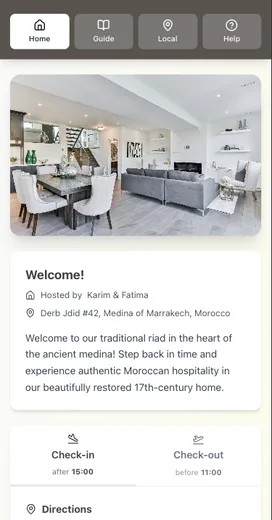
A digital welcome guide gives you a single place to store check‑in, WiFi, house rules, and local tips. If you want to make guest communication feel lighter, start with our Superhost Secret Weapon or the time audit in The Real Cost of Being an Airbnb Host.
Key takeaways
- Repetitive questions are an information problem, not a guest problem.
- Check‑in and communication are rated categories, so clarity affects reviews.
- Airbnb expects responses within 24 hours; fast replies help response rate and search visibility.
- One clear, visual guide can remove most repeat messages.
Resources
Related posts
- The Superhost Secret Weapon: What Top Hosts Do Differently
- Five-Star Airbnb Reviews: What 1,000 Reviews Reveal
- The Real Cost of Being an Airbnb Host: A Time Breakdown
- Airbnb Hosting Year in Review: A Simple Template