Five-Star Airbnb Reviews: What 1,000 Reviews Reveal
If you want more five-star Airbnb reviews, the fastest path is to learn what guests actually praise when things go right. So we did a simple, transparent analysis of 1,000 top-rated reviews to see what themes keep showing up.
This post is not a generic list of tips. It is a data-backed look at what guests repeatedly celebrate, plus the exact hosting actions that map to those themes. If you host one or two properties and want a clear, prioritized playbook, this is for you.
How we analyzed 1,000 five-star Airbnb reviews
Data source: Inside Airbnb public data for Asheville, North Carolina (dataset dated 2025-09-22). We used the detailed listings.csv.gz and reviews.csv.gz files. Inside Airbnb compiles public review data from Airbnb listings and provides it for research use.
Sample definition: Airbnb does not publish per-review star ratings in the public dataset. To approximate “five-star reviews,” we filtered to listings with an overall review_scores_rating of 4.9 or higher, then pulled the first 1,000 reviews with written comments.
Method: We used keyword tagging to detect themes (location, cleanliness, comfort, amenities, communication, check-in, accuracy, value), plus simple phrase counts (e.g., “great location,” “walking distance,” “highly recommend”).
Limitations: This is one city and one dataset snapshot. It is directional, not definitive for every market. The goal is actionable insight, not academic certainty.
The 6 themes that dominate five-star Airbnb reviews
Below are the strongest signals from our 1,000-review sample, with the share of reviews that mentioned each theme at least once.
1) Location wins (55.4%)
More than half of the reviews referenced location. Phrases like “great location” (8.7%) and “walking distance” (5.9%) show up constantly.
What this means for hosts: You can’t change where your home is, but you can frame it. Guests are explicitly telling you that proximity and walkability feel like wins.
Do this next:
- Add a simple “What’s walkable in 10 minutes” section to your guide.
- Mention transit options and drive times in your check-in message.
- Use listing photos that show the neighborhood, not just the interior.
“Location” isn’t just a map pin. It’s how easy the stay feels the minute guests step outside.
2) Comfort is a close second (44.3%)
Words like comfortable, cozy, quiet, and sleep were some of the most common descriptors in the dataset.
What this means for hosts: Guests often describe comfort before they describe design. The “feel” of the space is a top praise driver.
Do this next:
- Upgrade sleep basics first: mattress, pillows, blackout options.
- Reduce noise bleed (door seals, rugs, white noise).
- Label thermostats clearly and add one-sentence HVAC tips.
3) Amenities earn real praise (28.3%)
Amenities were mentioned in 28.3% of reviews. Guests love when the space has everything they need, and “everything needed” appeared in 4.3% of reviews.
What this means for hosts: “Well stocked” reads like “well cared for.” Missing basics are silent review killers.
Do this next:
- Build a one-page “amenities checklist” for turnovers.
- Make the WiFi info unmissable (card on desk + guide).
- Ensure your kitchen basics are complete (coffee, salt, oil).
4) Cleanliness still matters (26.1%)
Cleanliness was explicitly called out in 26.1% of the reviews. It is also a core rating category Airbnb asks guests to score.
What this means for hosts: Guests notice cleanliness when it is excellent and when it is not. It is a “floor,” not a “ceiling.”
Do this next:
- Use a visual cleaning checklist (mirror + light + photo spot checks).
- Add a “last 5 minutes” pass focused on bathrooms and kitchen.
- Consider scent neutrality (clean, not perfumed).
5) Communication shows up more than check-in (22.0% vs 12.3%)
Communication was mentioned in 22.0% of reviews, while check-in appeared in 12.3%.
What this means for hosts: Quick, clear communication matters more than elaborate messaging. Guests praise responsiveness and clarity, not volume.
Do this next:
- Send one focused pre-arrival message with access + parking + WiFi.
- Ask a single arrival question (“What time do you plan to arrive?”).
- Follow up once on the first night, then go quiet.
6) Accuracy and value are mentioned less, but still matter (5.8% and 2.3%)
Accuracy and value showed up less frequently in review text. That does not mean they are unimportant. Airbnb’s own guidance on great reviews emphasizes accurate listing details, cleanliness, and timely communication.
What this means for hosts: Guests may only mention accuracy when it fails, but it is still a core rating category. Think of it as silent risk, not silent irrelevance.
Do this next:
- Audit your listing photos every season (especially for outdoor spaces).
- Update anything that changes: parking, pet rules, noise notes.
- Remove “nice-to-have” claims if you cannot deliver consistently.
What this data suggests about five-star review psychology
When you map the themes above to Airbnb’s review categories (accuracy, check-in, cleanliness, communication, location, value), a pattern appears:
- Location and comfort are emotional wins. Guests write about them because they feel good.
- Cleanliness and accuracy are trust signals. Guests expect them and penalize when they are missed.
- Communication and check-in are friction reducers. They are praised when they prevent confusion.
In other words: reviews are less about luxury and more about friction-free confidence.
The five-star review blueprint (based on the data)
If you want a practical checklist, start here:
- Make location effortless. Add a “5-minute orientation” in your guide and highlight walkability.
- Prioritize sleep comfort. A good mattress outperforms any decorative upgrade.
- Stock the basics ruthlessly. Guests notice when things “just work.”
- Make cleanliness obvious. Visual cues matter: sparkle, order, and smell.
- Communicate with precision. Short, clear, and timed beats long and frequent.
Five-star reviews are won in the first 10 minutes and the last 10 minutes.
Want to apply this without adding more work?
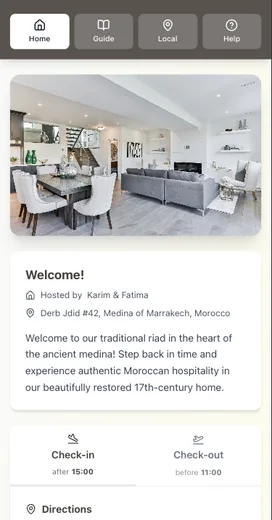
The easiest way to reduce guest questions and improve consistency is to centralize your guest information in one place. A digital welcome guide lets you keep check-in instructions, WiFi, local tips, and house rules clear, current, and easy to find.
If you want a simple starting point, read our Superhost Secret Weapon guide or How to Become Airbnb Superhost: A 4.8+ Ratings Playbook.
Conclusion
Five-star Airbnb reviews aren’t random. In our sample, guests repeatedly praised the same things: location framing, comfort, “everything we needed,” cleanliness, and clear communication that reduces friction. If you want more five-star Airbnb reviews, pick one theme you’re weak on and systematize it (checklists, a first-10-minutes guide, and clear, timed messages).
Key takeaways:
- Location praise dominates: 55.4% of reviews mention it in some way.
- Comfort is a major driver: 44.3% of reviews include comfort cues.
- Amenities show preparedness: 28.3% mention them.
- Cleanliness remains essential: 26.1% explicitly mention it.
- Communication beats check-in: 22.0% vs 12.3%.
- Accuracy matters even when it’s silent: low mention, high impact.
If you want to make these improvements stick, centralize guest info in one digital guide so you’re not rewriting the same answers. Related: The Psychology of 5-Star Reviews and 5-Star Airbnb Host: What Top Hosts Do Differently.
Resources
Related posts
- The Superhost Secret Weapon: What Top Hosts Do Differently
- How to Become Airbnb Superhost: A 4.8+ Ratings Playbook
- Airbnb Hosting Mistakes: 12 Mistakes and How to Fix Them
- Emerging Airbnb Trends: What Hosts Should Watch in 2026