Superhost Secret Weapon: What Great Hosts Do Differently
The Superhost secret weapon is not a bigger budget or a fancier property. It is a repeatable system for delivering a consistently smooth stay. If you are an individual Airbnb or VRBO host looking for practical, realistic improvement, this guide shows the exact behaviors that create 5-star reviews.
How we built these Airbnb Superhost tips: We used Airbnb’s published Superhost criteria and review categories, then focused on the actions that reduce guest friction (check-in, cleanliness, and clarity). For context, see Airbnb’s Superhost criteria and Ratings for homes.
Superhost Mindset Shift: Experience Over Property
Most hosts see themselves as landlords who happen to interact with guests. Top performers see themselves as experience designers who happen to own property.
This isn’t just semantics. It fundamentally changes every decision:
-
A landlord asks: “What do I need to provide?”
-
An experience designer asks: “What will make this stay memorable?”
-
A landlord asks: “How do I protect my property?”
-
An experience designer asks: “How do I make guests feel trusted?”
-
A landlord asks: “How do I handle problems?”
-
An experience designer asks: “How do I prevent problems before they happen?”
This mindset shift—from “what am I renting” to “who is renting”—is a common thread among consistently top-rated hosts. It cascades into every operational decision.
“The difference between a 4.7-star host and a 4.95-star host isn’t about having a nicer property. It’s about a completely different approach to hospitality.”
Airbnb Superhost Tips: Eliminate Friction Before It Happens
Average hosts react to guest questions. Elite hosts anticipate and eliminate them.
When a guest messages asking “Where do I park?” or “How do I work the thermostat?”, that’s a failure—not of the guest, but of the information system. Every question represents friction in the experience.
What top hosts do differently:
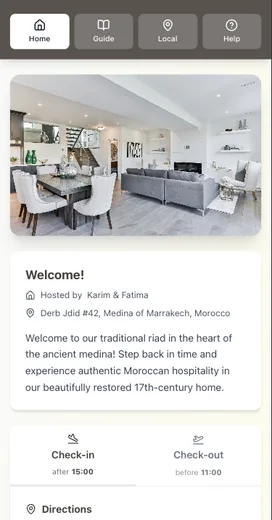
They document obsessively. Not with walls of text, but with clear, scannable information that guests can find in seconds. The WiFi password isn’t buried in paragraph 4 of a welcome message—it’s immediately accessible. A digital welcome guide makes this kind of organized, instant-access information possible.
They think in guest journeys. What does someone need to know:
- Before they arrive? (Directions, parking, access codes)
- In the first 10 minutes? (WiFi, thermostat, how things work)
- During their stay? (Local recommendations, house quirks)
- At checkout? (Simple, clear instructions)
They test their own experience. Walking through exactly what a guest does—from booking confirmation to checkout—reveals friction points that are invisible from the host’s perspective.
The 30-Second Rule
A useful benchmark: any question a guest might have should be answerable within 30 seconds of looking for it.
This means:
- Information is where guests expect it to be
- Instructions are visual when possible (photos beat paragraphs)
- The most common needs are the most accessible
Airbnb Superhost Tips: Communicate Strategically
There’s a common misconception that great hosting requires constant, chatty communication. The data suggests otherwise.
The pattern isn’t about more communication—it’s about faster, more strategic communication.
The Communication Pattern That Works
-
Pre-arrival (1-2 days before): Essential logistics only. Check-in time, access instructions, parking. No fluff.
-
Day of arrival: A brief, warm message confirming everything is ready. One question: “What time do you expect to arrive?”
-
First evening: One check-in message. “Just wanted to make sure you found everything okay. Let me know if you need anything.” That’s it.
-
Radio silence until checkout approaches, unless the guest initiates.
-
Checkout day: Clear, simple instructions. Thank you and invitation to leave a review.
Why Less Communication Often Means Better Reviews
Guests aren’t staying at your property to make a new friend. They want a smooth, comfortable experience—and constant messages interrupt that.
The exception: when something goes wrong, top hosts become immediately responsive and visibly proactive. The contrast between respectful distance and rapid problem-solving builds trust more effectively than constant hovering.
Many guest messages land outside traditional business hours, so templates and automated first responses help without sounding robotic.
Superhost Strategy: First and Last Impression
This is where psychology research provides clear guidance. The peak-end rule suggests people judge experiences largely by how they felt at the most intense point and at the end, not by averaging every moment. (For a research-backed walkthrough, see The Psychology of 5-Star Reviews.)
For hosts, this has direct implications: optimize the first 10 minutes and the last hour.
The First 10 Minutes
Hospitality research consistently shows that smooth arrivals create stronger overall satisfaction. The first minutes set expectations for the rest of the stay.
Top hosts obsess over:
Cleanliness that’s visible. Not just clean—obviously clean. Surfaces that gleam. That fresh, neutral scent. Towels folded precisely. It’s not about being fancy; it’s about demonstrating care.
Immediate orientation. Guests shouldn’t have to hunt for anything in those first crucial minutes. WiFi information visible. A clear sense of where things are. No confusion about which door to use or where to put their bags.
A small, thoughtful touch. This doesn’t mean expensive gifts. A handwritten welcome note. Local snacks. Fresh flowers. Something that signals: “We thought about you specifically, not just ‘a guest.’”
The Last Hour
How a stay ends matters enormously for reviews - the peak-end effect suggests endings disproportionately shape memory. Top hosts make checkout:
Simple. Strip the beds or don’t? Start the dishwasher or leave dishes? Ambiguity creates anxiety. Clear instructions—ideally just 2-3 steps—remove that stress.
Generous. “Check out by 11” hits differently than “Check out whenever you’re ready, just let us know if you need a late departure.” Even if the result is the same, the framing changes the feeling.
Warm. A simple thank-you message that feels personal, not automated. Mention something specific about their stay if you can.
Superhost Systems: Build Repeatable Habits
Here’s what separates hosts who maintain quality at scale from those who burn out: systems that work without willpower.
Average hosts rely on memory and good intentions. Elite hosts build checklists, templates, and processes.
What Gets Systematized
Turnover cleaning. Not “make sure it’s clean” but a specific checklist. Every surface, every appliance, every corner—written down and verified. Top hosts often photograph their cleaning completion as a record.
Guest communication. Templates for every scenario, but with placeholders for personalization. The structure is systematic; the details feel human. (For templates that actually work, see our getting started guide.)
Maintenance. A calendar of what gets checked monthly, quarterly, annually. HVAC filters, smoke detector batteries, mattress rotation. Problems prevented, not just fixed.
Inventory. Exact counts of towels, linens, supplies. Reorder points established. No guest ever encounters “we ran out.”
Why Systems Beat Effort
Managing multiple properties—or even one property consistently over time—requires removing reliance on willpower and memory. Every property gets the same attention because the checklist doesn’t have bad days.
This isn’t about being impersonal—it’s about freeing up mental energy for the moments that actually require human judgment and care.
Superhost Reviews: Focus on What Actually Matters
Not everything affects guest satisfaction equally. Research provides clear guidance on where to focus.
Cleanliness Dominates
Cleanliness is the single most influential factor in booking decisions and guest satisfaction. Guests can forgive a smaller space, but they rarely forgive a property that feels neglected.
What Guests Care About Most (In Order)
-
Cleanliness. Nothing else matters if this isn’t perfect. One hair in the bathroom sink can tank an otherwise excellent stay.
-
Check-in ease. Smooth, stress-free arrival. This is where most negative experiences begin.
-
Communication. Responsive when needed, unobtrusive otherwise. Clear information when it matters.
-
Accuracy. What they booked is what they got. No surprises, no “oh, we forgot to mention” moments.
-
Value. Not “cheap”—but worth what they paid. Guests assess this relative to expectations, not absolute price.
Notice what’s not driving satisfaction: fancy amenities, designer furniture, premium toiletries. These things can enhance a stay, but they don’t compensate for failures in the fundamentals.
The 80/20 of Hosting
Elite hosts understand that 80% of their results come from 20% of their efforts. They get cleanliness, check-in, and communication right every single time. Then they add thoughtful touches where possible—but never at the expense of the basics.
Superhost Problem-Solving Builds Trust
Every host encounters problems. A broken appliance. A noise complaint. A guest who’s unhappy. What separates elite hosts is how they respond.
The Response Pattern That Works
Speed first. Respond within minutes, not hours. Even if you can’t solve it yet: “I saw your message, I’m looking into this right now, I’ll have an answer within the hour.”
Acknowledge before solving. “That’s frustrating, I’m sorry you’re dealing with this” comes before “Here’s what I’ll do.” Guests want to feel heard, not managed.
Over-deliver on the fix. If something goes wrong, the remedy should exceed what fairness requires. A broken coffee maker doesn’t just get replaced—it comes with a gift card to the local coffee shop. The inconvenience gets acknowledged tangibly.
Follow up. After a problem is “solved,” check back. “Just wanted to make sure everything is working now.” This extra step signals that you actually care about the outcome, not just about closing the ticket.
The Paradox of Problems
Counter-intuitively, guests who experience a problem that gets handled exceptionally often leave better reviews than guests who had no problems at all.
The reasoning connects back to Kahneman’s peak-end research: a smooth stay is expected—it’s the baseline. But seeing how a host handles adversity creates a memorable peak moment. It makes the positive experience feel earned and trustworthy.
Superhost Strategy: Think Long-Term
Average hosts optimize for this booking. Elite hosts optimize for the next hundred.
This changes decisions:
They don’t nickel-and-dime. Charging for early check-in might make sense on paper. But the goodwill cost often exceeds the revenue. Top hosts give when they can, knowing it comes back in reviews and referrals.
They learn from every stay. Each guest is data. What questions did they ask? What confused them? What did they love? Every stay is an opportunity to improve the next one.
They invest in improvements. Average hosts see repairs as costs. Elite hosts see them as investments in future review scores.
They build reputation deliberately. A strong review history compounds over time, making every future booking easier.
The Real Superhost Secret Weapon
After reviewing the research and data, what’s the actual “secret weapon” that separates Superhosts from everyone else?
It’s this: they’ve decided that hosting is worth doing well.
Not adequately. Not “good enough.” Well.
That decision cascades into everything else:
- They notice details others overlook
- They fix problems others tolerate
- They anticipate needs others ignore
- They care about outcomes others accept
The systems, the communication strategies, the check-in optimization—these are all downstream of a more fundamental choice: to treat hosting as a craft worth mastering, not a chore to be minimized.
“80% of results come from 20% of efforts. Elite hosts get cleanliness, check-in, and communication right every single time.”
What This Means for Your Hosting
You don’t have to implement everything at once. But consider starting here:
-
Audit your guest’s first 10 minutes. Walk through your arrival experience as if you’ve never been there. What’s confusing? What’s missing? What could be better?
-
Count your guest messages. For your last 10 stays, how many questions did guests ask that your materials should have answered? Each one is a friction point to eliminate.
-
Document your turnover. If you’re relying on memory for cleaning and preparation, you’re guaranteeing inconsistency. Write it down. Check it off. Every time.
-
Simplify your checkout. Cut your checkout instructions to three steps or fewer. Guests don’t need homework; they need to leave feeling good.
The gap between average hosts and Superhost status isn’t talent or luck. It’s intention and systems. Both are available to anyone willing to invest in them.
Conclusion
The Superhost secret weapon is consistency: guests arrive without friction, find answers fast, and leave with a simple checkout that ends the stay on a high note. You don’t need to host “harder” - you need systems that make great hosting repeatable.
Key takeaways:
- The Superhost secret weapon is a system that removes friction before guests ever ask.
- Strategic communication beats constant communication when it is fast, clear, and human.
- First impressions and final moments shape reviews more than mid-stay details.
- Cleanliness, check-in, and accuracy drive most 5-star reviews.
- Long-term thinking builds a reputation that compounds.
Ready to Put These Principles Into Practice?
If you’re looking to implement these Superhost strategies, a digital welcome guide can systematize much of what we’ve covered—from instant-access information to consistent guest communication. Learn how to create your first digital guide and start building the systems that top hosts rely on.
What’s the one change from this article you’re planning to implement first? The best insights come from hosts sharing what actually works in their properties.
Resources
Related posts
- Getting Started with Be My Guest
- Emerging Airbnb Trends: What Hosts Should Watch in 2026
- Blog Archive