Printed Welcome Book Costs: Hidden Time, Errors, Waste
Printed welcome book costs are rarely just the printing bill. You design a binder once, print it, and leave it on the counter - but over a year, the hidden costs stack up in time, accuracy risk, guest friction, and waste.
This guide breaks down the real costs: time, accuracy risk, guest friction, and waste, plus what to do instead.
How we’re defining “cost” (beyond dollars)
This post treats costs as anything that increases:
- Guest effort (more searching, more confusion at arrival).
- Host work (more messages, more updates, more reprints).
- Accuracy risk (outdated instructions that create friction).
- Waste (paper that gets replaced over and over).
That framing matches how guests experience a stay: small frictions turn into messages and lower confidence.
1) The accuracy problem (and why it matters)
Airbnb explicitly asks guests to rate accuracy and check‑in, and it notes that the overall rating is its own category (not an average). That means outdated instructions can hurt you even if the home is great.
Airbnb’s hosting guidance also stresses keeping listings and instructions up to date, including seasonal details.
Why print creates hidden costs:
- When the WiFi password changes, the binder becomes wrong.
- If a seasonal amenity changes (pool closed, snow access), the binder goes stale.
- If check‑in steps change, the printed instructions create confusion.
Each outdated line increases the odds of a message, a negative note in a review, or a lower check‑in score.
2) The time tax of constant reprinting
Printed binders are “set‑and‑forget” only if nothing changes. But hosting is full of small changes: lock codes, parking rules, trash schedules, local restaurant closures.
Airbnb’s own guidance recommends step‑by‑step check‑in instructions and clarity around access. That clarity is hard to maintain in print, because every change becomes a reprint.
Hidden cost: each update becomes a project. Even small edits turn into printer runs, page replacements, and re‑laminating.
3) Guest friction: paper is slower than phones
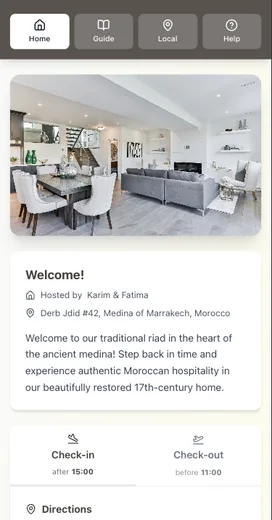
Guests are on their phones, and Airbnb’s check‑in info appears in the app. When they arrive, they need answers fast.
A printed binder is one more place to search. If they can’t find it, they message you. If they find it too late, they still message you. That creates more interruptions—and lower check‑in and communication ratings.
Pull quote: “If the answer isn’t found in 30 seconds, guests will text you.”
4) The sustainability cost adds up
Paper is still a large part of the waste stream. In 2018, paper and paperboard accounted for 23.1% of U.S. municipal solid waste (MSW), and 17.2 million tons of paper and paperboard ended up in landfills.
A single binder doesn’t feel wasteful. But when you add seasonal reprints, replacements, and multiple copies across multiple properties, the paper footprint becomes real.
5) Accessibility and multilingual gaps
Printed guides lock you into one format and one language. Larger type? Multiple languages? QR codes to quick answers? Those are all easy digitally, but expensive in print.
This is a hidden cost because it doesn’t show up on a receipt, but it shows up in guest confidence and time‑to‑answer.
The simple alternative: one living guide
A digital welcome guide gives you:
- Instant updates (no reprints)
- One source of truth (no confusion)
- Mobile-first access (what guests already use)
- Easy translations (if you host international guests)
This does not have to be complex. The goal is clarity, not extra work.
If you keep print, at least reduce the cost
If you prefer a printed binder, here’s the low‑friction version:
- Keep it short (1–3 pages).
- Put the most‑asked questions on page one.
- Use a QR code that links to the full, updated guide.
- Update the digital guide first, then print only if needed.
Conclusion
Printed welcome book costs show up in the places hosts hate most: extra messages, repeated updates, and avoidable guest confusion. If you keep a binder, keep it short and use a QR code to a living guide. If you want the lowest ongoing cost, move the “source of truth” to a digital guide and treat print as optional backup.
Key takeaways:
- Printed binders create accuracy risk, which affects ratings.
- Airbnb expects clear, up-to-date instructions, and print makes that harder.
- Paper waste is a meaningful environmental cost.
- A digital guide reduces guest questions and update time.
If you want a guide you can update in seconds (without reprinting), Be My Guest gives you a mobile-first welcome guide that stays current for every guest.
Resources
Related posts
- The Superhost Secret Weapon: What Top Hosts Do Differently
- Why Your Airbnb Guests Keep Asking the Same Questions
- The Real Cost of Being an Airbnb Host: A Time Breakdown
- Five-Star Airbnb Reviews: What 1,000 Reviews Reveal