Emerging Airbnb Trends: What Hosts Should Watch in 2026
Emerging Airbnb trends aren’t just headlines - they change what guests expect, what hosts need to automate, and what “good hosting” looks like week to week.
This guide focuses on trends that show up in operations (messages, check-in, pricing, and guest clarity), not speculative predictions.
How we chose these trends (so this stays grounded)
We used three filters:
- Guest-facing impact: does this change the questions guests ask or how they evaluate a stay?
- Operational impact: does this reduce (or increase) workload for a 1-2 property host?
- Credible signal: is there public evidence from platforms, industry datasets, or reputable research bodies?
Trend 1: AI shifts from “nice-to-have” to basic infrastructure
The practical change isn’t “AI writes your messages.” It’s that AI makes three hard parts of hosting easier:
- Pricing updates without constant manual tweaking
- Faster answers to routine questions (without sounding robotic)
- More consistent information delivery (less inbox chaos)
For small hosts, the biggest win is not fancy automation - it’s turning repeat questions into self-serve answers.
Practical move:
- Keep a single “source of truth” for check-in, WiFi, parking, and house basics, then link to it from messages.
Trend 2: Smart home tech becomes invisible (because guests expect it)
Smart locks and basic smart home features are no longer a novelty in many markets - they are part of “frictionless arrival.”
Practical move:
- Build a backup plan for access (battery checks, spare key, alternate entry instructions).
- Keep a simple troubleshooting section in your guide (lock, WiFi, thermostat).
If you want the psychology behind why arrival is so high leverage, see: Five-Star Airbnb Reviews: What 1,000 Reviews Reveal.
Trend 3: Longer stays and “work-friendly” travel continue to matter
Remote and hybrid work changed trip patterns in many markets: longer stays, more weekday bookings, and more scrutiny on WiFi and work setup.
Practical move:
- Make WiFi info instant and reliable.
- Offer a real workspace (even a small desk with a chair and good lighting).
Related: How to Share WiFi Password Airbnb: 7 Host Methods.
Trend 4: Sustainability expectations rise (without guests wanting guilt trips)
Guests increasingly expect basic sustainability signals: clear recycling instructions, energy-saving basics, and local recommendations that feel intentional.
Practical move:
- Add a short “how we do trash/recycling here” section.
- Recommend a few local, independent spots (grocery, coffee, dinner).
Trend 5: Regulations tighten, and compliance becomes an operations problem
Rules vary by city and change over time. The operational reality is that compliance affects:
- What you can claim in your listing
- What you can offer (or must provide)
- What documentation you need to keep
Practical move:
- Keep a simple “compliance folder” (permits, tax IDs, emergency info, building rules).
- Write house rules that match real constraints (noise, parking, occupancy).
Trend 6: Differentiation moves from amenities to clarity + consistency
As markets get more crowded, “nice design” alone is less defensible. The stays that stand out feel effortless: guests know what to do, where to go, and how to solve problems without waiting.
Practical move:
- Standardize the stay: checklists, saved replies, and a guide you update in minutes.
- Run a quarterly review so small issues don’t compound.
If you want a structured review template, use: Airbnb Hosting Year in Review: A Simple Template.
Conclusion
Emerging Airbnb trends in 2026 point to the same competitive advantage: reduce friction, stay current, and make information easy to find. Hosts who build systems around clarity (check-in, WiFi, house basics) will feel the benefits first: fewer messages, more consistent reviews, and less operational stress.
Key takeaways:
- AI and automation are most useful when they reduce repeat questions and pricing busywork.
- Smart home expectations mostly affect arrival and troubleshooting.
- Longer stays increase the value of WiFi and work-friendly setup.
- Sustainability and local impact are part of “modern hosting,” not a niche.
- Regulations and compliance require ongoing attention.
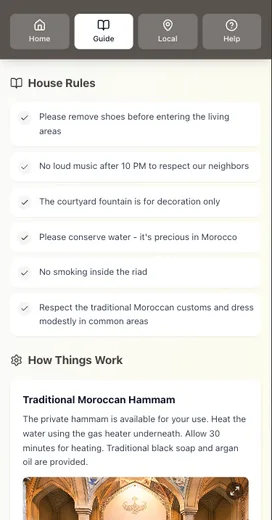
If you want to future-proof without adding more work, centralize guest info in one digital guide you can update instantly. Related: Guest Expectations Airbnb: How Hosting Has Changed and The Superhost Secret Weapon.
Resources
Related posts
- Guest Expectations Airbnb: How Hosting Has Changed
- Five-Star Airbnb Reviews: What 1,000 Reviews Reveal
- Airbnb Peak Season Preparation: A Month-by-Month Guide
- The Superhost Secret Weapon: What Top Hosts Do Differently