Digital Welcome Guide Examples: Before vs After (Host View)
Switching to a digital welcome guide isn’t just a format change. It changes when guests get information, how they access it, and how often you repeat yourself.
These digital welcome guide examples make the difference concrete: what changes before vs after you go digital-first.
This post shows a clear “before vs after” comparison based on common host workflows and Airbnb’s own guidance on guidebooks—so you can decide if the shift is worth it for your property.
How we evaluated the before vs after
We compared the experience across five guest‑critical moments:
- Pre‑arrival clarity (do guests know what to do before they arrive?)
- Check‑in confidence (can they enter without friction?)
- In‑stay questions (how often do they message for basics?)
- Checkout accuracy (do they follow steps correctly?)
- Ongoing updates (can you keep info current without reprinting?)
Airbnb’s guidance emphasizes keeping guidebooks brief, personal, and updated, and making them easy for guests to access in the listing or Trips tab. That’s the baseline standard we’re aiming for.
Before: the typical printed or PDF workflow
What it often looks like:
- A printed binder on the counter
- A PDF attached to a message
- Information spread across multiple messages
Common outcomes:
- Guests don’t read it until after they need it
- Small updates (WiFi, parking, check‑out) lag behind
- You answer the same questions every week
After: the digital guide workflow
What it looks like:
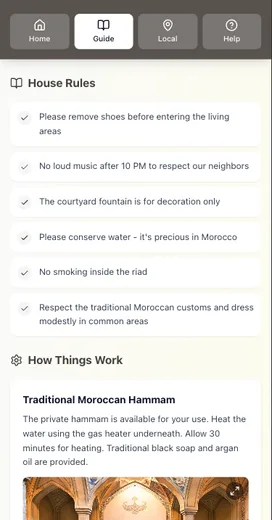
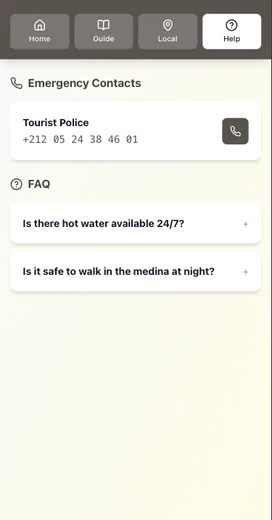
- One mobile‑first guide with the essentials at the top
- Shared in pre‑arrival + check‑in day messages
- Updated in minutes, not reprinted
Common outcomes:
- Guests have the info before arrival
- Fewer “how do I get in?” messages
- Less manual messaging for you
The transformation by moment
1) Pre‑arrival clarity
Before: Guests get a long message or PDF that’s easy to miss.
After: One link, easy to open on a phone, with check‑in steps at the top.
Because most adults own smartphones, mobile‑first access is the default guest behavior, not the exception.
2) Check‑in confidence
Before: Guests are searching their inbox or flipping through a binder after they arrive.
After: Check‑in steps are visible before they leave the airport.
If you want to tighten this further, use the structure in: Creating the Perfect Check-In Experience (Without Being There).
3) In‑stay questions
Before: Questions about WiFi, parking, trash, and house rules arrive one by one.
After: The guide answers the top questions in one place. You spend more time on exceptions, not repeats.
If repeat questions are still a problem, see: Why Your Airbnb Guests Keep Asking the Same Questions (And How to Stop It).
4) Checkout accuracy
Before: Guests forget a step because instructions were buried or outdated.
After: Checkout is a dedicated section, updated easily, and repeated the night before.
5) Updates and maintenance
Before: You edit, re‑export, and reprint.
After: You update once and every guest sees the latest version.
Airbnb’s guidebook tools are designed to be shared and updated, and guests can access them from the listing or Trips tab—so a digital guide fits the way the platform already works.
The simplest “before vs after” checklist
If you’re deciding whether to switch, audit your current setup:
- Do guests ask for info that already exists in your guide?
- Have you reprinted or resent your guide in the last 90 days?
- Do you send multiple messages with overlapping info?
- Do you have a single link that answers 80% of questions?
If you checked 2 or more, a digital guide is likely the better system.
Want to see an example layout?
We built a Digital Guide Layout Example that shows a mobile‑first structure with check‑in, WiFi, parking, house rules, and checkout at the top.
Conclusion: what “before vs after” really means
The best digital welcome guide examples all lead to the same outcome: guests get the right info before they panic-message you.
If you want the quick recap:
- Before: info is scattered (binder + PDF + messages), and updates lag.
- After: one mobile-first guide link, updated once, reused everywhere.
- Result: clearer check-in, fewer repeat questions, and a smoother checkout.
If you want to implement the “after” version fast, start by moving just the Quick Start (entry, WiFi, parking, checkout) into one guide and link it in your pre-arrival message.
Resources
Related posts
- Canva Welcome Book vs Digital Guide: A Complete Comparison
- The Mobile‑First Welcome Guide: Why Desktop Doesn’t Matter
- Creating the Perfect Check‑In Experience (Without Being There)
- Automation Without Losing the Personal Touch: A How‑To Guide
External sources