The Guest Experience ROI: Real Numbers for Airbnb Hosts
If “guest experience” feels hard to measure, you’re not alone. Most hosts feel it matters, but want to know how much it actually pays off.
That’s what we mean by guest experience ROI: the measurable revenue and risk reduction that comes from a smoother stay.
This post turns experience into numbers. We’ll use published research on review scores, pricing power, and occupancy to build a simple, conservative ROI model you can adapt to your own listing.
The three data points we used (and why they matter)
We grounded the model in three independent sources:
-
Review score → pricing power and occupancy (hotel industry). Cornell‑linked research using the ReviewPro Global Review Index (GRI) found that a 1‑point increase on a 100‑point scale is associated with +0.89% ADR, +0.54% occupancy, and +1.42% RevPAR.
-
Review sentiment → Airbnb pricing. A 2025 peer‑reviewed Airbnb study using Inside Airbnb data found that review sentiment is associated with pricing, alongside location and amenities.
-
Ratings → real revenue impact (service businesses). Harvard Business School research on Yelp ratings showed that a 1‑star increase can lift revenue by 5–9% in restaurants—a useful proxy for how ratings shift willingness to pay in experience‑driven businesses.
None of these are perfect Airbnb‑only proofs. But taken together, they give a realistic, conservative range for ROI.
The ROI model (simple and transparent)
Use this 4‑step model to estimate your upside.
Step 1: Your baseline
- Average nightly rate (ADR): $______
- Occupancy: ______% (nights booked / nights available)
- Nights available per year: ______
Baseline revenue: ADR × occupancy × nights available
Step 2: A conservative experience improvement
Use a modest assumption based on the Cornell/ReviewPro findings:
- ADR +0.5% to +1.0%
- Occupancy +0.3% to +0.5%
These are smaller than the Cornell study’s reported effects, which keeps the model conservative.
Step 3: Calculate the impact
Example (replace with your numbers):
- ADR: $180
- Occupancy: 62%
- Nights available: 300
Baseline revenue: $180 × 0.62 × 300 = $33,480
Apply a 0.8% ADR increase and 0.4% occupancy increase:
- New ADR: $181.44
- New occupancy: 62.4%
New revenue: $181.44 × 0.624 × 300 = $33,956
Estimated lift: $476/year
That’s the conservative version. If your reviews improve enough to move price or conversion more meaningfully, the upside compounds quickly.
Where experience improvements actually show up
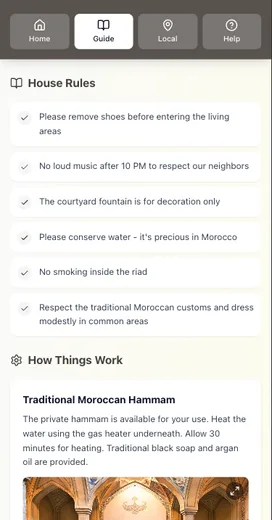
Based on host workflows and Airbnb guidance, the biggest “ROI levers” tend to be:
- Check‑in clarity (fewer frustrated messages, smoother arrivals)
- Accurate, updated info (fewer complaints and lower friction)
- Mobile‑first delivery (guests find answers fast)
- Personal touches (reviews mention care, not just cleanliness)
If you want a practical before‑and‑after view, see: Before vs After: How Digital Guides Transform Guest Experiences.
Why this matters even if you don’t raise price
The ROI isn’t only in price increases. It’s also in time saved and less review risk:
- Fewer repeat messages → fewer hours per week
- Fewer check‑in failures → fewer negative reviews
- Clearer expectations → better guest sentiment
That’s why hosts who focus on experience often see both revenue and time benefits.
The safest way to capture ROI
Start with a system that gives you two things:
- One source of truth (a guide you can update quickly)
- One delivery path (a link + a short offline backup)
That alone removes the most common points of guest friction.
If you’re ready to operationalize this, Be My Guest can help you build a digital guide that’s mobile‑first, easy to update, and designed to reduce repeat questions.
Want the ROI worksheet?
We built a simple Guest Experience ROI Worksheet you can plug your own numbers into (ADR, occupancy, nights available) to estimate your upside.
Conclusion: guest experience ROI is real (and usually conservative)
Even with conservative assumptions, guest experience ROI shows up in two places:
- Revenue upside: better conversion and pricing power (even small lifts compound over a year).
- Downside protection: fewer check-in failures, fewer urgent messages, and fewer review surprises.
Start small: fix the top arrival friction point, keep your info current in one place, and track what changes for 30 days. If you want the fastest “system” upgrade, make your guide the source of truth and send one link in every timed message.
Resources
Related posts
- Before vs After: How Digital Guides Transform Guest Experiences
- Automation Without Losing the Personal Touch: A How‑To Guide
- How One Host Saved 10 Hours Per Week (And You Can Too)
- Creating the Perfect Check‑In Experience (Without Being There)
External sources