Digital vs Printed Welcome Book: Criteria-Based Verdict
If you’re torn between a printed welcome book and a digital guide, you’re not alone. This is a digital vs printed welcome book decision: which format actually helps guests and saves you time?
This isn’t a vibes debate. It’s a criteria‑based decision you can apply to your own property. We’ll compare both formats across access, accuracy, maintenance, and guest behavior so you can make a confident call.
The criteria we used to settle it
We scored print vs digital on five practical hosting criteria:
- Guest access (can guests find it without asking?)
- Accuracy over time (does the info stay current?)
- Update speed (how fast can you change something?)
- Friction for you (how much work does it add?)
- Guest experience (does it feel easy and helpful?)
This matters because Airbnb’s own guidance emphasizes making guide information easy to find and easy to keep updated. If your format makes either of those hard, it’s working against you.
Round 1: Guest access
Printed: Guests only see it if they notice it.
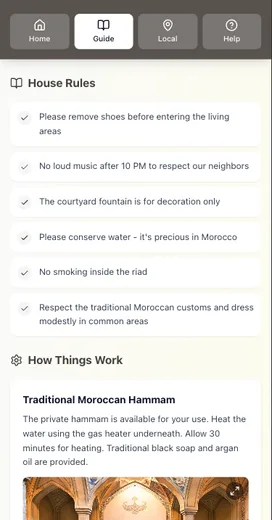
Digital: Guests can access it before arrival through a link you send, and Airbnb guidebooks are accessible from the listing or Trips tab.
Winner: Digital — it meets guests where they already are: on their phones. Pew Research Center reports that 91% of U.S. adults own a smartphone, making mobile access the default, not the exception.
A guide that lives on a phone beats a binder that lives on a counter.
Round 2: Accuracy over time
Printed: Every change requires editing, exporting, and reprinting.
Digital: One update, instantly live for every guest.
Winner: Digital — especially if you update WiFi, access codes, or local recommendations even a few times per year.
Round 3: Update speed
Printed: Edits take time and often get delayed.
Digital: You can edit in minutes, from anywhere.
Winner: Digital — this is the difference between “I’ll fix it later” and “fixed in two minutes.”
Round 4: Friction for you
Printed: Printing, replacing pages, and checking for outdated info adds recurring work.
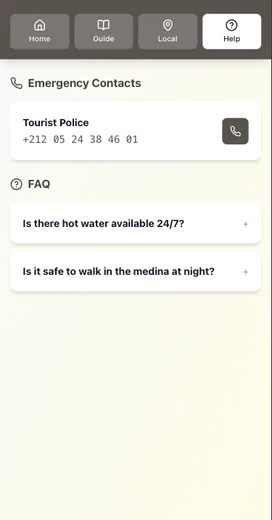
Digital: One system to update, one link to share.
Winner: Digital — fewer touchpoints means fewer forgotten updates.
There’s also a practical waste component. The EPA reports that paper and paperboard made up 23.1% of U.S. municipal solid waste in 2018 (67.4 million tons). Reprinting guides isn’t a huge environmental footprint by itself, but it’s a reminder that print scales poorly.
Round 5: Guest experience
Printed: Looks polished, feels tactile, but is static.
Digital: Easier to navigate, searchable, and always current.
Winner: Tie (with a slight edge to digital).
The best guest experience often uses both formats: a short printed quick‑start sheet plus a digital guide as the source of truth.
The verdict (and the simple rule of thumb)
If you update anything more than once a quarter, go digital‑first. If your information rarely changes and your guests love physical materials, a printed binder can still work—as a backup, not the primary system.
Quick decision guide
- Digital‑first: changing WiFi, codes, local tips, or rules regularly
- Print‑only: very stable info + low‑tech guest profile
- Hybrid: digital guide for updates + one‑page printed quick start
Want the one‑page comparison chart?
We put together a Printable vs Digital Comparison Chart you can use to audit your current guide and decide what to upgrade first.
Conclusion
Digital vs printed welcome book isn’t about aesthetics - it’s about access and upkeep.
- If guests need the info before arrival (check-in, parking, WiFi), digital wins.
- If your info changes at all (codes, WiFi, recommendations), digital wins.
- Print still helps as a one-page quick-start backup for the first 10 minutes.
If you want the most reliable setup, go digital-first with a short printed quick-start sheet.
Related reading:
- Canva Welcome Book vs Digital Guide: A Complete Comparison
- Why Your Airbnb Guests Keep Asking the Same Questions (And How to Stop It)
- The Offline Advantage: Why Your Guest Guide Needs to Work Without WiFi
Resources
Related posts
- Why Superhosts Are Ditching Printed Welcome Binders
- Canva Welcome Book vs Digital Guide: A Complete Comparison
- Printed Welcome Book Costs: Hidden Time, Errors, Waste
- Why Your Airbnb Guests Keep Asking the Same Questions (And How to Stop It)
External sources